

Tax Reform: Northern Senators In Closed-door Meeting
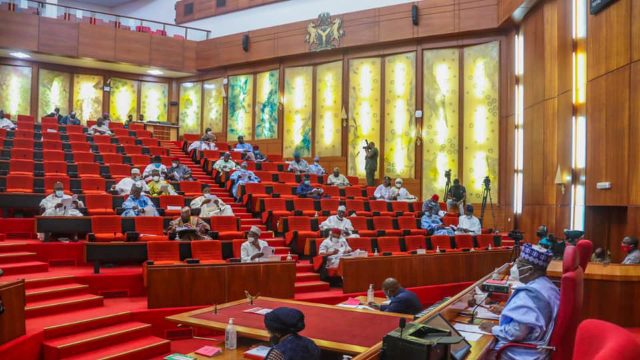
Northern Senators met behind closed doors on Thursday following the upper chamber’s passage of the Tax Reform Bills for a second reading.
The meeting announced during the plenary, was held in room 301 and lasted about two hours.
However, the details of the conversation remained unknown as the Chairman of the Northern Senators Forum, Senator Abdulaziz Yar’Adua, declined comment after the session.
Earlier on Thursday, the Senate tasked its Committee on Finance to invite governors, the Governors Forum, traditional rulers, and other stakeholders to attend a public hearing on the bills.
This followed the passage of the controversial bills for a second reading after a debate, after which they were referred to the Finance Committee, which was directed to revert in not more than six weeks.
Before the debate, the lawmakers had gone into a closed-door session.
On their return from the executive session, the Senate Leader, Opeyemi Bamidele ( APC, Ekiti Central) led the debate.
President Bola Tinubu had in October sent four tax bills to the National Assembly.
The bills include the Tax Reform Bills comprising the Joint Revenue Board of Nigeria (Establishment) Bill, 2024; Nigeria Revenue Service (Establishment) Bill, 2024; Nigeria Revenue Service (Establishment) Bill, 2024 and Nigeria Tax Bill, 2024.
When the bills were initially introduced, the northern governors rejected them, describing them as anti-democratic.
Following this, the National Economic Council, Nigeria’s highest economic advisory body, requested that the tax reforms bill be withdrawn from the NASS for more consultations.
Oyo State Governor, Seyi Makinde, announced the council’s position after its 144th meeting chaired by Vice President Kashim Shettima at the State House, Abuja.
Makinde said council members agreed that the bill be withdrawn as some sections of the country are uncomfortable with some of its sections.
He said this would allow for consensus building and understanding.
He announced, “Today, NEC took a presentation from the Chairman of the Presidential Committee on Fiscal Policy and Tax Reforms.
“After extensive deliberation, NEC noted the need for sufficient alignment between and amongst the stakeholders for the proposed reforms.
“So, council, therefore, recommends the need to withdraw the bill currently before the National Assembly on tax reforms so that we can have wider consultations and also build consensus around these reforms for the benefit of the entire country.”
Following the various controversies that greeted the bills, the Senate on Wednesday invited the president’s economic team led by the Chairman of the Presidential Committee on Fiscal Policy and Tax Reforms, Taiwo Oyedele, alongside the Chairman of the Federal Inland Revenue Service, Zacchaeus Adedeji and the Director-General of the Budget Office, Tanimu Yakubu, to the plenary to explain the bills in detail.
Bamidele, while leading the debate, reeled out proposals contained in the Tax Reform Bills, which according to him, aim at simplifying the tax landscape, reducing the burden on small businesses and streamlining how taxes are collected.
The legislation sought to increase the Value Added Tax distributable to the sub-national governments to 55 per cent while reducing the Federal Government’s share to 10 per cent.
The new legislative regimes also proposed zero VAT on exports and essential consumptions and VAT credit on assets and services in addition to goods consumed by businesses to lower the cost of production.
Bamidele noted that those whose salaries are not more than the minimum wage from Pay As You Earn deductions would be exempted from the tax regime.
He also said small businesses with an annual turnover of N50 million or less “are equally exempted from payment of taxes,” a key pro-business initiative that encourages job creation; deepens ease of doing business and incentivises more investments.
Similarly, the senate leader explained that there was a proposed huge reduction in company income tax from the current 30 per cent to 25 per cent that would last for at least two years.
He said, “As part of a deliberate attempt to curtail the incidence of double taxation and multiplicity of taxes and levies, multiple taxes hitherto paid by companies under various tax heads namely 2.5 per cent education tax, 0.25 per cent NASENI tax have been harmonized into a development level of 2 per cent which by 2030 will be applied to fund the newly established student loan scheme which will benefit many Nigerian youths.
“Unlike what is obtainable under the existing tax regime whereby the Federal Government takes a lion’s share of VAT revenues, it is proposed that the sharing formula should allow the state government to share 55 per cent of VAT revenue from the current 15 per cent to 10 per cent sharing formula.’’
“However, the local government’s share of VAT revenue remains unaffected. Relatedly, basic items consumed by Nigerian households such as food items, medical services and pharmaceuticals, educational fees, electricity, etc are exempted from VAT.
“Again, as part of efforts to ease the administration of income taxes and levies across the federation, there is a reasonable effort made to consolidate core tax statutes and related tax legislations,” Bamidele explained.
Contrary to misrepresentations in the public domain regarding the intendment of the bills under consideration, Bamidele explained that the bills contained innovative and people-oriented proposals as part of the government’s deliberate fiscal and tax reform measures to cushion the effect of ongoing broader economic policies such as the removal of subsidy on petroleum products and renew efforts to implement cost-reflective electricity tariffs in the power sector on Nigerian citizens, among others.
During the debate, the bills were supported by the minority leader, Abba Moro, (PDP, Benue South), Sani Musa ( APC, Niger East) and Seriake Dickson (PDP, Bayelsa West) and Tahir Mongunu (APC, Borno North).
In his contribution, the Chairman of the Senate Finance Committee, Sani Musa, stated that the bills’ objectives are good for the country.
He assured that the committee would give the bills the legislative processes it required, calling for memoranda from all stakeholders.
Senator Seriake Dickson emphasized the importance of tax reforms and their role in fostering fiscal federalism.
He stated, “The current administration aims to ensure that governments at all levels operate primarily on tax revenue, which I fully support. However, in a country as diverse as Nigeria, it is natural for issues to arise.
‘’These reflect our unique cultural, regional, and economic expectations. It is our duty to harness these differences and enact laws that serve the national interest.”