


YABATECH Council Chair Leads College To Tourism Glory, Receives ATPN Honorary Fellowship Award
– Governing Council Chairman’s groundbreaking research paper charts new direction for national tourism development
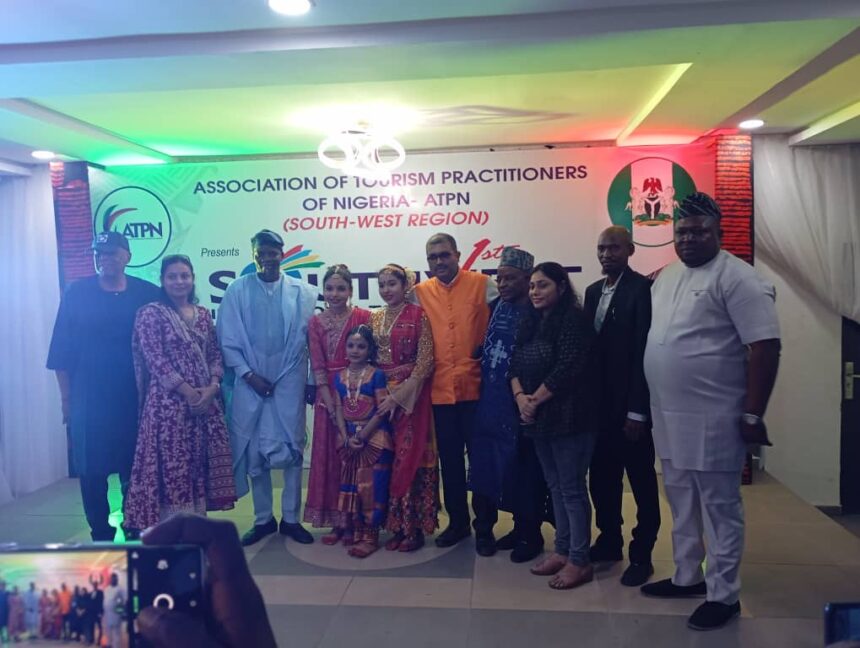
The reputation of Yaba College of Technology (YABATECH) as a trailblazer in creative and technical excellence was further reinforced as the Chairman, Governing Council, Professor Funso Afolabi, was conferred with the prestigious Honorary Fellowship Award by the Association of Tourism Practitioners of Nigeria (ATPN) at the 2025 Southwest International Tourism Expo (SWITE), held at Lagos Airport Hotel, Ikeja.
The honour coincided with the College’s emergence as the Best Tourism Tertiary Institution in Southwest Nigeria, marking a double celebration for the institution and highlighting its growing influence in Nigeria’s tourism and creative sectors.
Prof. Afolabi, a distinguished academic, tourism researcher and cultural development advocate, was celebrated for his extensive contributions to community-based tourism, collaborative development frameworks, and tourism education in Nigeria.
His conferment came alongside YABATECH’s outstanding performance at the expo, where students of the Department of Tourism Management Technology delivered exceptional cultural displays, exhibitions and craftsmanship – earning them the coveted regional award.
Vice President of ATPN, Hon. Samson Apata, said the College’s performance “spoke for itself,” noting that YABATECH excelled above nearly 15 competing institutions from Nigeria and Ghana.
During the ceremony, Prof. Afolabi presented a compelling paper on tourism collaboration, community-based development, and national security in tourism environments, drawing from a major research study covering Osun, Ekiti and Ondo States.
His findings revealed no significant collaboration among the three states in their tourism business choice – a gap he attributed to lack of awareness about the importance of collaboration, poor understanding of types and benefits of tourism partnerships and insufficient knowledge of collaboration procedures.
He emphasized that these gaps continue to weaken tourism development across communities.
Prof. Afolabi highlighted new areas that could transform community-based tourism, including modern tourism curriculum designs, joint local, national and international tours, festival and events calendar harmonization, mountain race planning and execution, security and safety gadgets for hospitality establishments an coastal states’ joint National Fishing Festival.
He also recommended strategic partnerships between states such as Igede-Ekiti and Osogbo for a joint annual Igede–Osun Osogbo Festival, as well as a tri-state “IYAN-DAY” celebration between Enugu, Benue and Ekiti States.
One of the most discussed aspects of Prof. Afolabi’s presentation was his bold call for the revival of traditional Yoruba “Sigidi/Ereju” anthropomorphic security figures, historically used for protection and warfare.
He urged ATPN to convene a national conference of traditional custodians – Babalawos, Abofas and Abores – to develop a modern, regulated model for using these cultural technologies as security reinforcements around hotels, inns and travel facilities.
According to him, colonial administrations borrowed elements of the Sigidi model in early robotic development, insisting that Nigeria must reclaim and modernize this heritage.
He recommended that ATPN should formalize the initiative through a national Memorandum of Understanding, Joint safety projects, Co-marketing strategies, Risk–reward and monitoring frameworks
Prof. Afolabi’s concluding message emphasized that tourism development must be rooted in research, structured collaborations, and cultural intelligence.
“What is worth doing at all is worth doing well. When practice is guided by sound research, communities will prosper,” he declared.