



Xenophobia: FG To Seek Compensation From South Africa For Nigerians’ Abandoned Properties
The federal government has said it would seek from its South African counterpart compensation for Nigerians forced to abandon businesses and other valuable properties as they returned home, following renewed anti-immigrant tensions in the country.
This came as 269 more Nigerians arrived Lagos in the third government’s evacuation flight, thus bringing the total number so far evacuated to 603.
This comprises the 268 airlifted by Air Peace on June 11 in the first batch; 66 evacuated by ValueJet on July 25 in the second batch; and the 268 brought home yesterday by Air Peace.
Speaking during an appearance on Channels Television’s The Morning Brief as the evacuees touched down in Lagos yesterday, Acting Nigerian High Commissioner to South Africa, Temitope Ajayi, said government had already begun compiling records of businesses and properties left behind by returnees.
He added that the information will form the basis of discussions with the South African authorities on possible compensation.
The envoy said: “In terms of the businesses, just three days ago, myself and the South African Deputy Minister of Finance were together and we were discussing this.
‘’I took up the discussion with her and we have agreed that we are going to ask our people who are returning to begin to document what they are leaving behind, and that was the message yesterday (Monday, June 29) before this set that is due to land in Lagos.
“I have asked them before they left yesterday to document very accurately those things they were leaving behind in terms of businesses, in terms of even cars, movable and immovable properties. We can now take it up with the South African government. That is the next step we are going to take.
“So, this repatriation will not end with just taking people to Nigeria; we are going to systematically follow up on the information given to us, and I told them to be very accurate with what they are going to give because we are going to work with the South African government to get to the exact locations of all these businesses, shops and properties and present them to the South African government for possible compensation because we will not allow the labour people have suffered to build over the years to just go down the drain or be taken over by people.’’
He reiterated his earlier stance that majority of Nigerians living in South Africa were legal residents, saying most of them entered the country through legal immigration channels.
According to him, delays in the processing of immigration documents by South Africa’s Home Office have left many foreign nationals stranded, despite having initially migrated legally.
“In the last three or four years, there have been a deluge of applications at the South African Home Office which were not attended to due to systemic issues.
‘’So, because of this, many, not only Nigerian nationals, were caught in this web of delay, so you cannot rightly claim that these were undocumented because most of them came to the country legally in terms of how somebody should migrate.
“So, it is on the basis of now wanting to renew their papers that they were caught up in the unnecessary delays. So, when people try to say they were undocumented, I quite disagree with that because some of them, based on experience, have had their papers lag behind at the Home Office for years”.
Nigerians in SA say protest largely peaceful
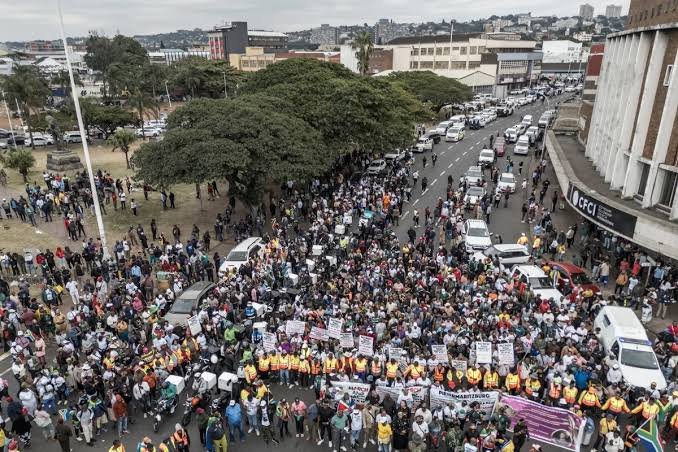
However, Nigerians on ground in South Africa yesterday said the June 30 protests had remained largely peaceful due to heavy security deployment.
Pretoria had, meanwhile, launched one of its largest domestic security operations in recent years, deploying 13,000 law enforcement officers, drones, helicopters and more than 33,000 CCTV cameras across Gauteng Province, as authorities seek to prevent a repeat of the deadly unrest that crippled Africa’s most industrialised economy in 2021.
The operation, which Acting Police , Firoz Cachalia, said would cost about R600 million ($35.5 million), comes amid mounting concerns that protests organised by anti-illegal immigration group March and March could descend into violence despite government warnings that criminal acts will not be tolerated.
Businesses, freight operators and shopping centre owners have also stepped up contingency plans ahead of the demonstrations, fearing disruptions in Gauteng, KwaZulu-Natal and the Western Cape, the country’s three biggest economic regions.
A Nigerian residing in Johannesburg, who simply identified himself as Madueke, said that protesters were marching as planned, adding that the entire country was on standstill.
He noted that businesses were shut down, while people stayed indoors due to the anti-immigrant protests and fear of attacks.
He, however, said the presence of security personnel, including the military, kept the situation calm.
“They are marching and singing, but they are not destroying things as it’s usually the case because the government deployed the army to follow the protesters and ensure there is no destruction of properties and killing. So, you have the military following the protesters anywhere they go.