

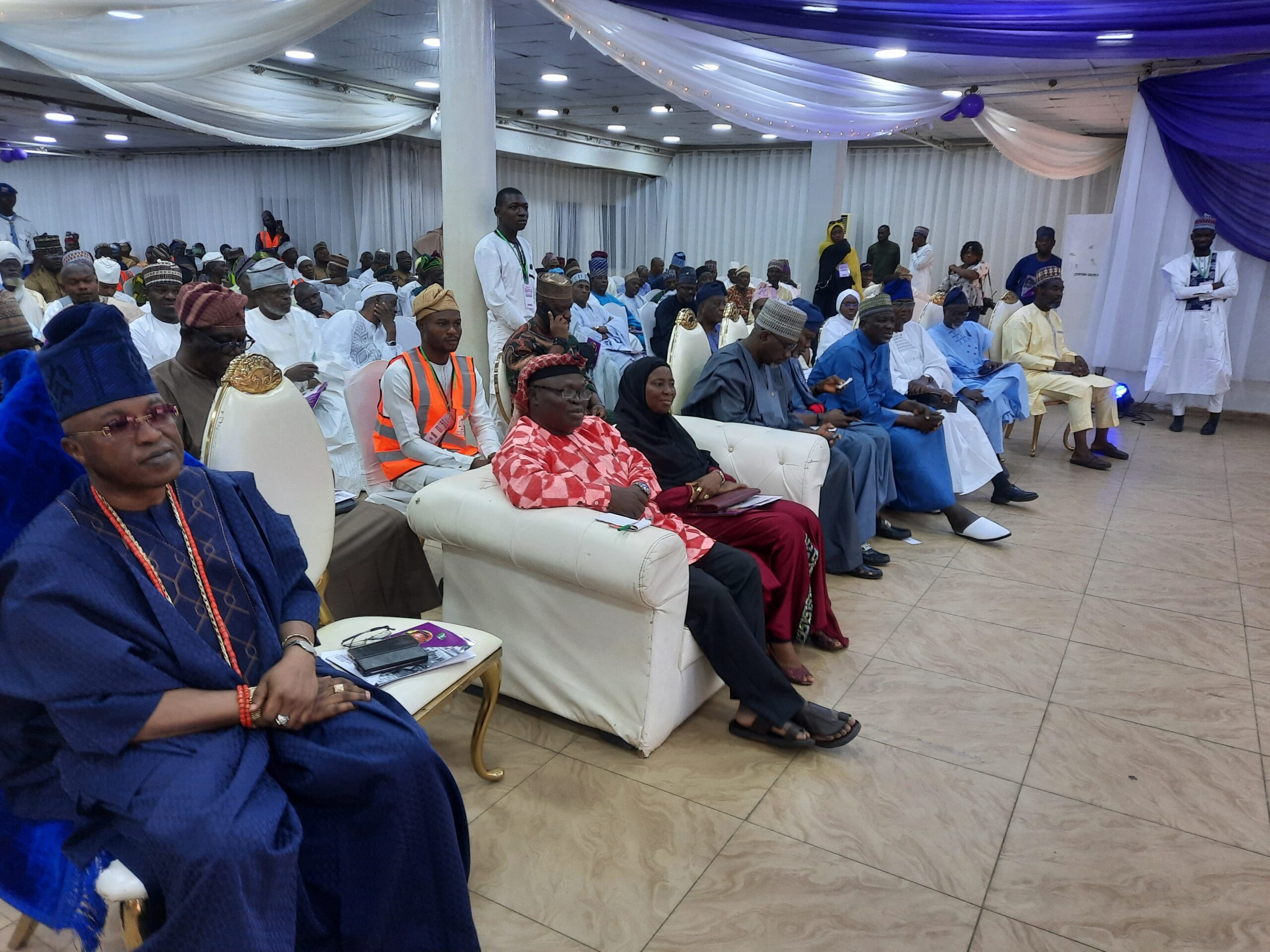

Akintola: El-Rufai, Oluwo, Pantami, Oladejo, Others Present At Retirement, Book Launch Ceremony
The much mouthed all-important occasion of the celebration of the retirement and book launch of Nigeria’s foremost faith-based human rights group leader, Professor Ishaq Lakin Akintola, finally came to fulfillment in Lagos on Sunday July 9, 2023.
Akintola, who retires formally from the service of the nation as Head of Department of Religion, Lagos State University (LASU) 39 years after, was honoured with the presence of many quality personalities and dignitaries that thronged the event Combo Hall of Lagos State Television (LTV8), Agidingbi, Ikeja in the Centre of Excellence.
They included the immediate past Governor of Kaduna State, Mallam Nasir El-Rufai, who attended for himself as Keynote Speaker; Deputy President-General of the Nigerian Supreme Council for Islamic Affairs (NSCIA) and President Muslim Ummah of South West Nigeria (MUSWEN), Alhaji Rasaki Oladejo; Deputy Secretary-General NSCIA, Professor Salisu Shehu; the Oluwo of Iwo, Oba AbdulRasheed Adewale Akanbi; the Chief Imam of Lagos, Engr. Sulaimon Oluwatoyin Abou-Noulla; Chairman Oyo State Muslim Council, Alhaji Kunle Sanni; Chairman Yusuf Olaolu Ali Foundation, Mallam Yusuf Alli (SAN); Governor of Lagos State Babajide Sanwo-Olu represented and representatives of LASU academic communities, among others.
Chairman of the occasion Mallam Yusuf Olaolu Ali (SAN), who practically took charge for more effective coordination of the event, in his address, called on Nigerians to stop seeing things from tribe and religion’s sentiments.
Lauding the contributions of Professor Akintola to the peace and unity that Nigeria has recorded across tribes and religious bounds, the Senior Advocate of Nigeria, urged that, “We should what is right always”.
Deputy Governor of Lagos State, Dr. Obafemi Hamzat, who represented Governor Babajide Sanwo-Olu, saluted the courage of Professor Akintola saying, “You have made Islam appealing”.
In his keynote address, former Governor of Kaduna State Mallam Nasir El-Rufai, who is also an awardee of Muslim Rights Concern (MURIC) at the event, re-iterated his commitment to seeing a Nigerian society that is devoid of conflicts especially from issues of injustice.
He wanted that worshipping of God be returned into private for peace of the nation.
El-Rufai continued by saying that the emergence of President Bola Ahmed Tinubu from the South West has achieved certain realities in Nigeria’s history.
Speaking further on this he listed among other such achievements that “We have replicated Hope ‘93”, destroyed the notion that only Christianisation will lead to election success, the notion that leadership from the South must be Christian has been permanently settled and destroyed the belief that North will not release power to the South.
Going down the memory lane, the former Kaduna governor bought forth how religion and tribe had not really mattered back then, as he said both religion and tribe were silent.
“Islam requires us to govern with justice; our Muslim-Muslim ticket treats everyone equally. No any Islamisation took place,” El-Rufai said.
He said, “Islamic principles say a leader must be fair to everyone,” even as he went into the Bible with a quote from the book of proverbs chapter 13 verse 14: “Righteousness exalts a nation”, Leviticus 19 verse 18: “Thou shall love thy neighbours.”
He said in the Bible, justice, righteousness, fairness to all are the basic targets: “love thy neighbour as theyself”. He added that injustice is not Islamic.
To the chagrin of the former governor, “Many do not practice what the religion preaches. Our politicisation of religion is not the best for Nigeria,” he warned as he said, “Faith is a direct relationship between an individual and God.”
Mallam Nasir El-Rufai said, “Not only people who speak like you or worship like you can treat you better. Let our merits as individuals recommend us for leadership,” he said.
He concluded his keynote address on a good note of commendation of the personality of Professor Ishaq Lakin Akintola and prayer for him.
“May the rest of your life be the best of your life,” El-Rufai prayed for the retiring professor, saying the time for his human rights activism has just started.
The book titled, “MY JIHAD: The autobiography of an Islamic eschatologist cum human rights activist”, was reviewed by Professor Mahfouz Adedimeji, Vice Chancellor of Ahman Patigi University, Patigi, Kwara State, Nigeria.
In his book review titled, “Courage is hard: A review of Ishaq Lakin Akintola’s My Jihad”, Professor Mahfouz, who started by stating the context, noted that, “For Prof. Ishaq Lakin Akintola, an enigmatic personality that evokes both intense admiration and undisguised hostility from many Nigerians, the rationale for his autobiography is to tell his own story by himself in order to avoid controversies about his life after his death and beat “post-humorous merchants of falsehood at their nefarious game” (p.iv).
“Perhaps, what the foremost Islamic eschatologist did not realise he was doing was to provide a roadmap through which the younger Muslim generation would be able to find their way in the vast jungle of life.
“Without equivocation, I aver that here is a book that every conscionable Muslim would wish he had read in his formative years and every conscious Muslim would be inspired by.”
Earlier under the ‘context’, he defended what Professor Akintola did by bringing forth an autobiography that by through which he appears to have blown his own trumpet, saying, “When the Greek statesman and general, Pericles, said that what you leave behind is not what is engraved in stone monuments but what is woven into the lives of others, he was only emphasising the need for us to leave indelible momentos that would impact future generations.
“Thus, for reasons ranging from setting records straight and helping one to take one’s place in history to understanding one’s personal journey through life and engaging in self-discovery, people with talent have often embraced autobiography as an art form since St Augustine of Hippo pioneered it in the year 400 with his Confessions.”
The Vice Chancellor, who started by telling the meanings of names the celebrant bears as they relate to the things that he has done, simply said the meaning of Akintola is “courage is sufficient a wealth” and that Lakin means to “have courage”.
Then he buttressed this by going down the memory lane to his days of student activism as undergraduate at Al-Azad University, Cairo, Egypt (the first university in the world as Akintola himself once said), his master’s in University of Ibadan and Ph.D in University of Ilorin and his human rights from the days with Chief Gani Fawehinmi, others as he joined the Campaign for Democracy.
He then touched on Chapter Three of the book, which he said talks about the character and personality of Professor Ishaq Akintola and how he said in 2018 that he would not bury his father and bury his money.
Lakin, according to him, was a poor lecturer who lived in a neighbourhood without letting his landlady know he was university lecturer. He, however, later became a landlord in the same neighbourhood, elected chairman of Landlord Association of the community and his former landlady became his vice chairman.
He said Lakin Akintola is a prince that rejected the offer to become a king and compared him with Nelson Mandela, who wrote in 1961 that “Struggle is my life”.
On the book “My Jihad”, the reviewer observed that Ishaq Akintola’s struggle was devoid of violence and was so much part of him that one of his daughters was named Jihad.