

Bauchi Gov, Minister Raise The Alarm Over Fake News Threat
Bauchi State Governor, Bala Mohammed and the Minister of Information and National Orientation, Mohammed Idris, on Wednesday, raised concerns over the growing threats posed by fake news, misinformation, and disinformation to Nigeria’s stability.
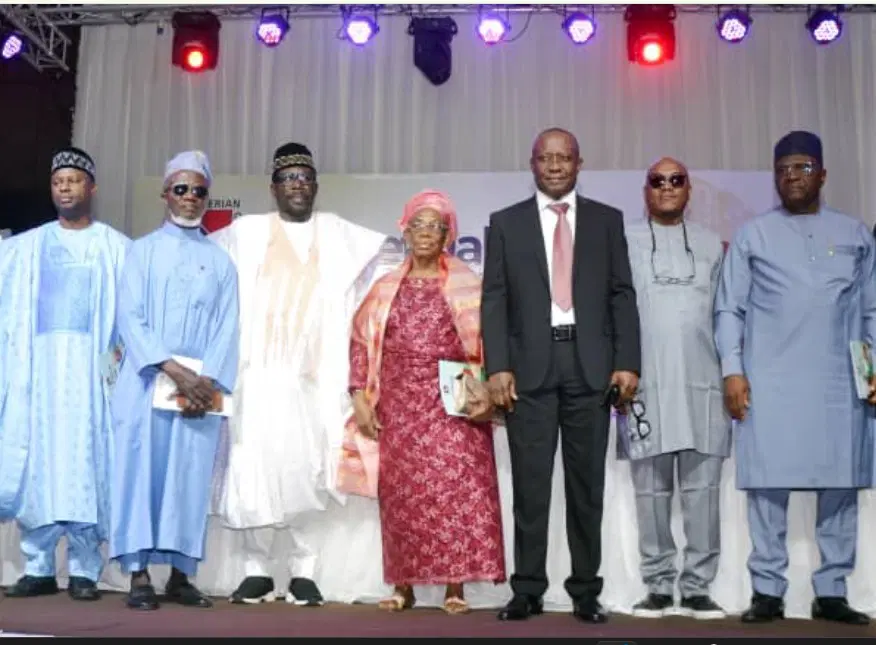
Both leaders spoke at the third edition of the Lateef Jakande Annual Memorial Lecture, with the theme: “Journalism and the challenges of nation building in a multi-ethnic society,” held in Ikeja, Lagos.
In his remarks at the event organised by the Nigerian Guild of Editors, Mohammed, represented by his Chief of Staff, Dr Aminu Gamawa, likened today’s digital age threats to the dark years of press suppression under colonial and military rule.
He said, “The digital age has opened the floodgates of information and misinformation. Social media has democratised speech but also diluted truth. Artificial intelligence now creates headlines, but who checks the heart behind them?”
The governor lamented that editorial independence was under siege, with media houses tempted to sacrifice truth for access to the deep pockets of politicians and corporations competing to control narratives.
Amid these pressures, he warned that nation-building would remain elusive unless the media fulfilled its watchdog role, including defending the rule of law, demanding credible leadership, promoting civic education, national reconciliation, and language inclusion.
He added, “The moment a society begins to ignore judicial decisions, it is on the path to lawlessness. No nation can survive selective justice. The media must call out every instance where court orders are flouted — not because of who is involved, but because of what is at stake: the soul of the republic.
“Journalists must question every candidate, scrutinise every promise, and highlight integrity over popularity. Elections should be contests of ideas, not identities. Leadership must never be reduced to entitlement.
“Nigeria must confront its past. We can no longer sweep historic grievances under the rug. A Truth and Reconciliation Summit, led in part by the media, could help heal our wounds. The media must fix its broken windows. Exploiting interns, hoarding opportunities, turning a blind eye to corruption within — these must stop. The pen must remain clean to remain powerful.”
In the same vein, the Information Minister, represented by Special Adviser to President Bola Tinubu on Information and Strategy, Mr Bayo Onanuga, warned that the nation risks being set ablaze if fake news is unchecked.
He slammed those self-proclaimed journalists who operate simply because they possess smartphones and Internet access and warned trained professionals against following such “citizen journalists” in disseminating unverified content.
Idris said, “What we have today is that the media industry is being challenged. We have all kinds of people calling themselves journalists. They have muddled things up.
“As a result, we have many cases of misinformation and disinformation being sent out in the name of being professionals. The Nigerian Guild of Editors must ensure that those who want to practice journalism keep to the rules of engagement.
“There are so many people in our profession who are gatecrashers – who, because they have a smartphone with an Internet connection, you see them sending out news and information, which most of the time is fake news, fake information.
Referencing a recent example, Idris cited the false report that Muhammed Babangida, son of former military president, Gen Ibrahim Babangida (retd.), rejected a government appointment—an account later debunked by Babangida himself.
“Recently, there was news in the media of the son of Ibrahim Babangida rejecting a government appointment with a letter purportedly written by the young man. It turned out that the young man said he did not write the said letter and that he had actually accepted the appointment and even showed his face in the office.
“Many of us here retweeted, reprinted that lie. There are rules. Don’t always retweet what you find on social media. Most often, they are not correct. If you get any piece of information, check to ascertain its correctness. If it is not correct, don’t use it. Don’t say because somebody has written it, it is the gospel. You need to verify it.
“If you keep writing fake news all over the place, one day, with our pen, we will set our country on fire, because fake news travels a lot and before you retract it, many would have gone ahead to believe what has been said or published by some these unscrupulous people who call themselves journalists, publishers, online.”
Other contributors at the event included Managing Director/Editor-in-Chief of The PUNCH, Mr Joseph Adeyeye; a former National Commissioner of the Independent National Electoral Commission, Prof Lai Olurode; former Special Adviser on Media and Publicity to President Muhammadu Buhari, Mr Femi Adesina; former NGE President, Mrs Funke Egbemode; and former Managing Director/Editor-in-Chief of The Guardian, Mr Emeka Izeze.
Also in attendance were the matriarch of the Jakande family, Mrs Sikirat Jakande; former Lagos Deputy Governor, Mrs Sinatu Ojikutu; NGE President, Mr Eze Anaba; Lagos State Commissioner for Information and Strategy, Mr Gbenga Omotoso; Special Adviser to Ogun State Governor on Media and Strategy, Mr Kayode Akinmade; Senior Special Assistant to Governor Umo Eno on Lagos Liaison, Mr Michael Effiong; and Founding Editor of The Guardian, Mr Lade Bunuola.
Olurode, who chaired the occasion, argued that the poverty of leadership was a major challenge that the nation faced, rather than its division along the lines of religion and ethnicity.
He argued that leadership should be for the public good, as he argued that no serving or dead governor has matched the record of leadership set by Jakande as governor of Lagos state for only four years.
In his remarks, Adesina urged the media to maintain its activist stance for a better Nigeria and drive the national consciousness agenda.
He charged the NGE and the Nigerian Union of Journalists to take the lead in correcting wrongs in the industry and upholding professional ethics.
Adesina said, “Nigeria has always been divided and is still divided. If the media must champion national reconciliation, help build a reconciled country, then it must eschew petty sentiments – religion, ethnicity.
“The media fought for independence; fought the military for democracy; and now that we have democracy, we are still fighting to entrench democracy. Nigeria’s media was born into activism, and it must remain activist. And it must not stop activism if we are going to build the kind of country that we desire.”
Izeze acknowledged that the role of journalists in nation-building has become more complex due to technology and digital media.
Notwithstanding the pressure, Izeze cautioned journalists against becoming appendages to the government, being too attached to public officials, which he said would cripple their ability to hold the government accountable.
Izeze said, “Journalists are expected to hold public office holders to account; they are expected to ask them inconvenient questions. The media should not be an appendage to the government.
“Journalists have become too respectful, too close, too attached to governors and other public office holders – sometimes we have become too fearful. As a result, journalists conveniently look the other way.
“By doing this, we no longer become solutions but partners to the problem of society. Journalists must be guided by the fact that when journalism fails, the nation fails.”
Egbemode, on her part, described citizen journalists as “hackers, not professionals,” and called for deliberate efforts to “rescue the pen from irresponsibility.”
She also advocated for stronger training for journalists to prevent further cracks in the profession.
“There is a need to train journalists, in-house, to be professionals. This is imperative as there is a need to rescue the pen from irresponsibility. We must train the next generation not to widen the cracks in the profession,” Egbemode stressed.
In his submission, The PUNCH MD, Adeyeye, urged the government to consider providing direct and indirect media subsidies to help the press fulfil its nation-building role.