

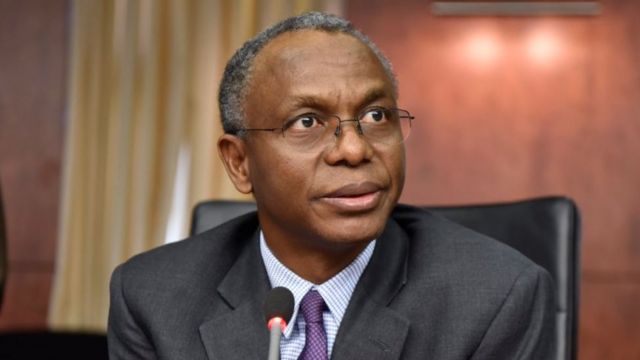

Decentralise Police, Power, Judiciary Now, El-Rufai Tells FG
The Governor of Kaduna State, Mallam Nasir El-Rufai, has re-echoed his call for the establishment of state police, devolution of power to the component units and decentralisation of the judicial system to tackle the exigencies of present times, because Nigeria is at war with criminal and divisive elements bent on bringing the country to its knees.
The governor made the call Thursday at the 18th Town Hall Meeting entitled: ‘Setting Benchmarks for Enhancing Security and National Unity in Nigeria’, held at Kaduna State University, Kaduna, which was organised by the Federal Ministry of Information and Culture.
El-Rufai stated that bandits and terrorists tormenting the country have all lost their right to life and should be wiped out. He stressed that the current security situation calls for national consensus as Nigeria is at war.
El-Rufai, who blamed the Nigerian state for not rising up to its duties in dealing with the escalating crisis in the country also blamed the insecurity on lack of coordination among security agencies, adding that the judicial system has become a safe haven for criminals due to undue delay in the prosecution of criminals.
He called on the security agencies to identify, and deal decisively with all state and non-state actors engaged in conducts that amount to challenging the supremacy of the Nigerian state and the Constitution without ethnic profiling or discriminatory treatment.
According to the governor, to address the banditry problem in the Northwest and north central, “we must implement the National Livestock Transformation Plan already produced two years ago to enable accelerated investment in modern animal husbandry, incorporating the rapid sedentarisation of herders in known locations.”
He said: “This country does not have enough soldiers, uniformed police and secret police to protect citizens across its vast swathes, particularly the forests. The limited number of boots on the ground are not well equipped and are significantly lacking in the technology that can make their limited numbers matter a lot. Centralised policing in a federation is not only a contradiction in terms. The state governments today bear most of the burden of the running costs of the Federal Police anyway, so why not the sub-nationals, the state police now. So I repeat my persistent call for state police as soon as possible.”
The governor, who also heads the ruling All Progressives Congress (APC) committee on restructuring, had last December, said the draft bill produced and submitted by his committee in January 2018 was stepped down for fear of politicization ahead of the 2019 general elections, promising that the draft bill would be given consideration before the present administration ends its tenure.
The Minister of Information and Culture, Alhaji Lai Mohammed, noted that the general state of insecurity, as reflected in incidences of farmers/herders clashes, Boko Haram insurgency, banditry, ethno-religious clashes and intolerance, cultism, drug addiction and kidnapping for ransom, are triggering rising call for secession as well as politicization of ethnic and religious differences.
He said: “How did we get here and what can we do to change the narrative? We believe that finding a way out of the situation in which we have found ourselves requires teamwork, reflecting all diversities and leveraging on all our collective creativity to pursue with diligence the project of rescuing Nigeria.”
The minister argued that the correct starting point towards addressing the myriad of problems is the building of an “elite consensus” on security, unity, indissolubility and peaceful existence of Nigeria, adding that such elite consensus had worked in the past.