


Insecurity: Obasanjo, Gumi Advocate Amnesty For Bandits Willing To Surrender
Former President Olusegun Obasanjo and the Kaduna-based Islamic Scholar, Sheikh Ahmad Abubakar Gumi on Sunday recommended special courts to try bandits, kidnappers and those found with unlawful weapons in the country.
This was contained in a joint statement issued and personally signed yesterday in Abeokuta by both Obasanjo and Gumi after a closed-door meeting that lasted close to four hours.
The duo of Obasanjo Sheikh Gumi emphatically declared that the only means through which the menace of banditry, kidnapping and ransom payment could be overcome in Nigeria is for the federal government to “wean those who are ready to be weaned out of the bushes and crime, settle and rehabilitate them, give them skills, empower them and let them have employment”.
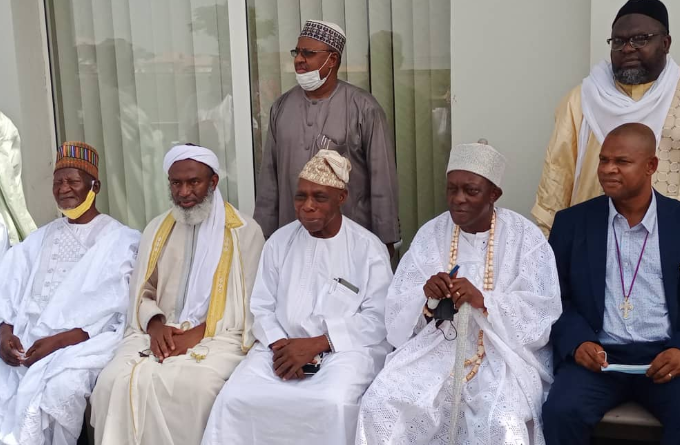
The popular Kaduna-based Islamic scholar, Gumi had on Sunday afternoon, visited Obasanjo at his Hilltop Mansion located within the Olusegun Obasanjo Presidential Library (OOPL) in Abeokuta, the Ogun state capital on a private visit where issues of national security, particularly the recent happenings in the South-West where Fulani herders are being accused of being behind the spate of kidnappings across the region.
Upon arrival, Gumi and his entourage went straight into the closed-door meeting where some traditional rulers in Egbaland, the state Chairman of the Christian Association of Nigeria (CAN), Bishop Tunde Akin-Akinsanya, the Chief Imam of Egbaland, Sheikh Sa’addallah Alade Bamigbola among others were already waiting.
In the statement issued at the end of the meeting, both Obasanjo and Gumi identified lack of good education as well as economic disparities as some of the principal factors fuelling the menace if insecurity in Nigeria and came into the conclusion that there is the need for both state and federal governments to evolve short, medium and long-term solutions towards overcoming the challenges.
Part of the solutions, according to the statement, however, included the use, “of stick and carrot for the offender and the vulnerable”, whereby the hardened criminals must be hard hit with a stick”.
“We acknowledge that people from different parts of the country and outside the country are involved although some people are more predominantly involved than others.
We must not advertently or inadvertently, in words, action or inaction encourage or support criminality”.
“We acknowledge that the security situation has gone beyond tolerance, hence Sheik Gumi’s coming to Abeokuta to confer with Chief Olusegun Obasanjo.
“We identified the crisis as a micro ethnic conflict between the Fulani and many host communities mainly in the North West”.
“We identified the remote causes as educational and economic disparities and the negative use of religion and ethnicity by unscrupulous politicians.
“Unlawful carrying of arms should be very seriously punished. Federal government should take the issue up seriously within ECOWAS to work for a regional solution”.
“Every community must be encouraged and empowered to stand firm and strong against criminals.
The meeting also advocated for a special protection and reward covertly for whistle blowers against criminals living in the community.
“Let the slogan be: Security is the responsibility of all Nigerians. We agree to continue to work together for solutions for the security of Nigeria and to seek others to join us as we widely circulate our joint statement”.
The Obasanjo – Gumi’s meeting further agreed that Nigerians should desist from ethicizing, religionizing as well as regionalizing these crimes, while respects for one another individually, community-wise, locally, ethnically, religiously and socially should be encouraged in ways that “show tolerance and accommodation where necessary”
“To this end, Sheik Gumi has extended an invitation to Chief Obasanjo to visit Kaduna with a view to continuing the discourse started today and Chief Obasanjo has graciously accepted”.
“We conclude that to keep Nigeria safe and secure for all Nigerians and others living in Nigeria is a task that all well-meaning Nigerians must engage in, separately and collectively”.