

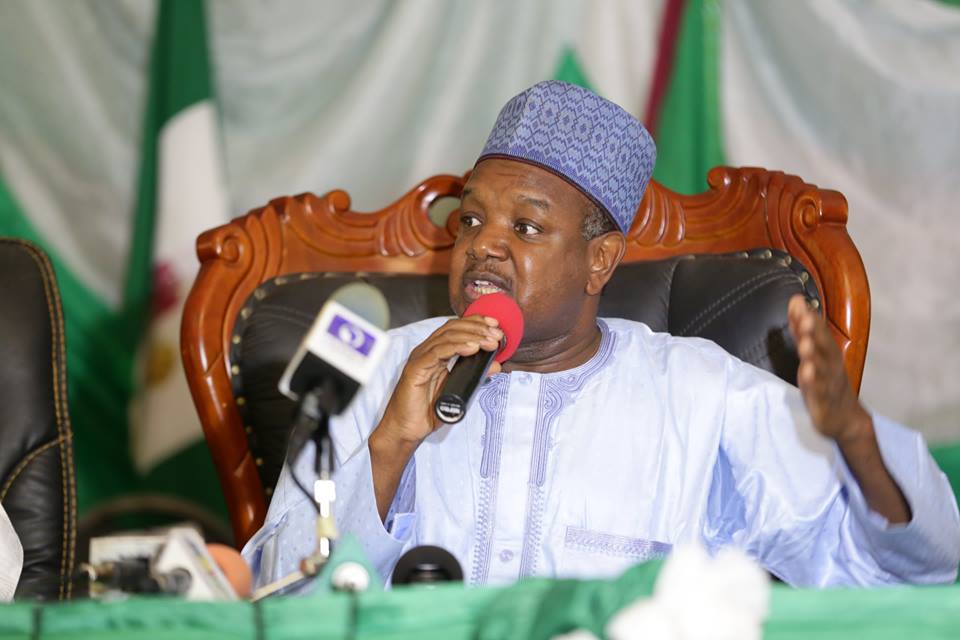

Minister Seeks World Bank Support For Ward Development Programme
The Minister of Budget and Economic Planning, Senator Abubakar Bagudu, has called on the World Bank to back Nigeria’s Renewed Hope Ward Development Programme, a grassroots initiative aimed at boosting local economic activities and helping achieve President Bola Tinubu’s target of a $1 trillion economy by 2030.
This was according to a press statement from the ministry on Thursday.
The statement read, “Minister of Budget and Economic Planning, Senator Abubakar Bagudu, has called on the World Bank to support the Renewed Hope Ward Development Programme, which seeks to boost economic activities at the nation’s grassroots.”
Speaking in Abuja on Thursday during a meeting with the bank’s new Country Director, Mr Matthew Verghis, Bagudu described the initiative as a “transformative programme” designed to map economic opportunities in all 8,809 wards across the country.
“The objectives, among others, are to promote sustainable and inclusive growth at the ward level, which will contribute to national development.
“This will support the $1tn GDP target by 2030 and help lift all Nigerians out of poverty,” the minister said.
He explained that the initiative, recently approved by the National Economic Council, would be coordinated by his ministry but implemented in partnership with all tiers of government.
“We have examined China’s experience of lifting 852 million people out of poverty, India’s rural transformation, and Kenya’s bottom-up strategy. Nigeria can incorporate these lessons, but with a model that reflects our constitutional federalism and ensures all three tiers of government take responsibility,” Bagudu added.
The minister also linked the programme to Nigeria Agenda 2050, the country’s long-term economic blueprint.
“Agenda 2050 is ambitious but achievable. It reflects our national consensus—enshrined in Chapter Two of our Constitution—that all tiers of government must work together to deliver economic, social, and environmental objectives. Our duty is to translate this vision into actionable five-year plans and annual budgets that are people-centred and results-driven,” he said.
Bagudu thanked the World Bank for its consistent backing during what he described as 28 months of difficult but transformative reforms.
“The World Bank team has collaborated with us not just as partners but as members of the same team. We could not have achieved the results we have today without your support,” he said.
He maintained that Nigeria must sustain the momentum of its economic reforms.
“Our reforms have demonstrated the value of staying the course in the right direction. With effective policies and difficult but necessary choices, we are beginning to see results. The task now is to build on these achievements and ensure that no willing Nigerian is left behind,” he added.
Bagudu reaffirmed that his ministry would not compete with others but coordinate development efforts.
In his response, Verghis commended Nigeria for undertaking bold reforms, describing them as a “development breakpoint” that could reset the nation’s trajectory.
“Nigeria’s recent decisions represent a critical moment. Such choices are not easy, but they create opportunities for a new path. The World Bank stands ready to continue supporting Nigeria in maintaining these reforms and increasing their impact,” he said.
He hailed the ward development initiative as timely and practical.
“The challenge is not just in designing new programmes but in building on what already works. Existing projects such as NG-CARES and the Nigeria for Women Project have established effective structures.
“We are eager to expand on these models, bring in global experience from India, China, and Kenya, and provide both technical and financial support to strengthen implementation,” Verghis added.
He stressed that grassroots development must align with Nigeria’s long-term priorities.
“We understand the objectives are jobs, prosperity, and inclusion. For the poorest, immediate support is needed; for the youth, opportunities for productivity; for the nation, a pathway to sustained growth. These are challenges we want to work with you to address,” he said.
The meeting, which was Verghis’s first official engagement with the ministry since assuming office, reaffirmed the strong partnership between Nigeria and the World Bank in promoting inclusive growth, poverty alleviation, and sustainable development.
In August reported the World Bank approved a total of $8.40bn in fresh loans to Nigeria over the past two years, according to data obtained from the bank’s official website.
The approvals, covering June 2023 to August 2025, cut across 15 projects in energy, education, healthcare, rural infrastructure and governance.
The amount comprised $1.95bn from the International Bank for Reconstruction and Development and $6.50bn from the International Development Association.
The International Bank for Reconstruction and Development provides loans on commercial or near-commercial terms to middle-income and creditworthy low-income countries, while the International Development Association offers highly concessional loans and grants to the world’s poorest nations.
Nigeria secured $122.19m in grants for two projects.