

Sanwo-Olu To Opposition: ‘Put Forward Credible Ideas That Can Compete With Ours…’
The Governor of Lagos State has challenged opposition parties to put forward credible ideas that are able to compete with the transformation agenda of the ruling All Progressives Congress (APC) instead of seeking change for the sake of change.
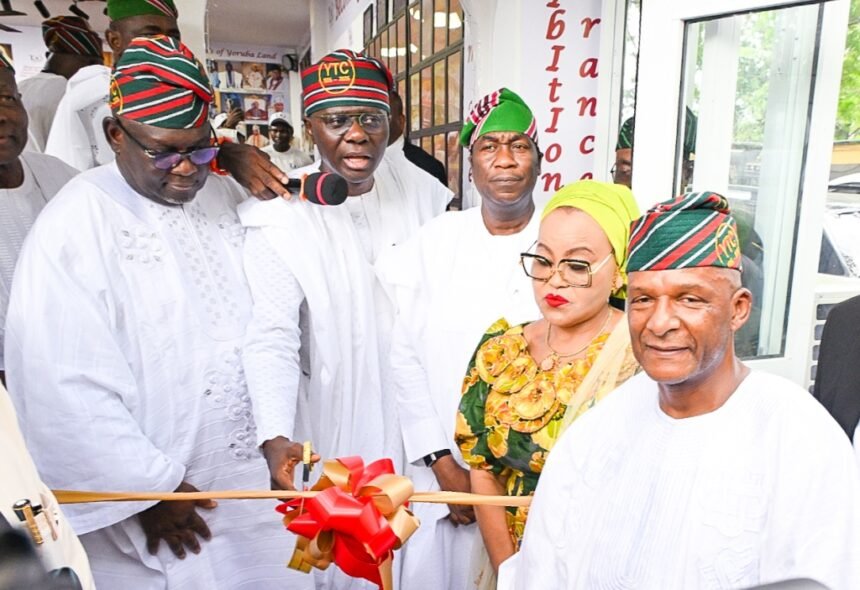
Governor Sanwo-Olu spoke on Tuesday while delivering the Centenary Anniversary Lecture of the Yoruba Tennis Club. The event was attended by the First Lady, Dr. Ibijoke Sanwo-Olu; Deputy Governor and Lagos State All Progressives Congress (APC) gubernatorial candidate, Dr. Obafemi Hamzat; public office holders, political and traditional leaders, members of the Yoruba Tennis Club and dignitaries, among others.
Titled: “Democracy, Governance, and the Lagos Spirit: A Century of Excellence, the lecture was held at the Greetings Hall of the Yoruba Tennis Club, Onikan in Lagos.
Governor Sanwo-Olu, who is the South-West Zonal Coordinator of the APC Presidential Campaign Council, declared that untested novelty is no longer an option for a Lagos State and now, Nigeria that has tasted and felt the superiority of continuity.
“We must keep insisting that it cannot be changed merely for the sake of change. We must never think we need to tear things up just to prove that we are in control. This is the message that I am taking into the political campaign, as my party strives to build on our legacy of transformation in Lagos State.
“And also, at the National level where our own Asiwaju Bola Ahmed Tinubu will be flying the flag of our All Progressives Congress (APC) as the presidential candidate. As I have always said, the gains of the bold reforms he has undertaken are now visible in foreign exchange stability, education, agriculture and security, among many others.
“Our challenge to the opposition remains the same – to put forward credible ideas that are able to compete with ours, instead of seeking change for the sake of change. Untested novelty is no longer an option for a Lagos State that has tasted and felt the superiority of continuity,” he declared.
Governor Sanwo-Olu described the “Lagos Spirit” of courage, self-reliance, openness and continuous improvement as a major force behind the State’s democratic tradition, governance and development.
He described Lagos as a city that does not wait to be given, recalling its role in the June 12 pro-democracy struggle, the development of indigenous political institutions and its long history of civic activism.
Governor Sanwo-Olu said Lagos’ development since the return of democracy in 1999 has been driven by continuity, with successive administrations building on the development blueprint initiated under former Governor Bola Tinubu, who is now President of Nigeria.
He said: “The Lagos Spirit is the spirit of a city that does not wait to be given. In 1926 it was shut out of the colonial clubs, so it built its own, and a better one. In 1993, a free and fair presidential vote was stolen, so Lagos chose to lead the march to the streets and into the pro-democracy trenches.
“In 2004, its constitutionally allotted allocation was illegally withheld by the federal government, so it decided to make its own money. Every time a gate has been closed to Lagos, Lagos has built a house across the road and thrown a better party.
“Lagos is not just Nigeria’s former administrative capital and current commercial nerve-centre, but also the country’s longstanding home of democracy and political activism. It is the birthplace and engine of the June 12 pro-democracy movement. In the arena of political governance, too, Lagos is just as visible and influential.”
Governor Sanwo-Olu also identified four habits that define what he called the “Lagos Playbook” for governance — vision, self-reliance, partnership and measuring governance by its impact on ordinary citizens.
He said: “The first habit is the vision. In 1999, when democracy returned, this State did something remarkable and rare. It crafted a blueprint – the brainchild of the then Governor, Asiwaju Bola Ahmed Tinubu, and his brilliant team of technocrats. Every Governor who has followed has faithfully built on that blueprint. It’s been 27 years now, and we have not departed from the original vision.
“Much of the Lagos that we can see today is because leaders like Governor Lateef Jakande and Governor Bola Ahmed Tinubu saw a picture that stretched far beyond their time in office. Continuity is the reason the Blue and Red Lines run today, as the first rail services ever built and operated by a sub-national government in the history of this country.
“The second habit is self-reliance. When the federal government vindictively closed its purse to us, Lagos did not become a beggar. It turned to its own people. It reformed its tax administration, modernised its fiscal architecture, and asked Lagosians to pay for their own city. They did. Today this State raises more of its own revenue than any other in the Federation.
“The third habit is partnership. Our founders did not wait for the European Club to open its doors, or for the colonial government to build them an Indigenes’ club. They instead looked for and found land, here in Onikan, and raised the money to develop the original club premises from their own pockets.
“The fourth habit is that governance is measured at the bottom, not the top. The true measure of our work in Lagos is whether a doctor or nurse in Alimosho or Ibeju-Lekki can get to work on time, whether a child in Ajegunle has a desk and school books, whether a trader in Mile 12 can get her tomatoes or fish to market before they rot, whether a taxi driver can make enough money to maintain his vehicle and cater for his family.”
Speaking on his administration’s performance in the last seven years, he said the incumbent government through its THEMES+ development agenda has impacted millions of Lagos residents in the areas of traffic and transport, health and environment, education and technology, the economy, tourism and entertainment, security and governance.
He said: “We have accomplished a great deal: built, improved, reformed, restored, and reset. We have established two new public universities, and built one of Africa’s largest rice mills at Imota.
“We have attracted hundreds of millions of dollars in investments into submarine cable landings and new data centres, laying the foundation for a digital revolution that before now could only be imagined. We are building West Africa’s largest children’s hospital, and bringing digital technology to public school classrooms.
“To cater to our N5.89 trillion per annum food market in Lagos, we are building the Lagos Central Food Security System and Logistics Hub in Ketu-Ereyun, to show the world that an African megacity can defy its severe land limitations and operate efficiently in the agriculture space by focusing on modernising the aggregation, storage, processing and distribution of its food.”
Reflecting on the Yoruba Tennis Club’s 100-year history, Governor Sanwo-Olu said the establishment of the club was a bold response by indigenous Lagosians to racial segregation in colonial-era Lagos, noting that the founders demonstrated the same courage and self-belief that have continued to shape the city.
He urged the Yoruba Tennis Club to preserve its founding values while continuing to evolve, stressing that institutions must embrace change without losing the ideals that made them relevant.
Governor Sanwo-Olu also called for greater inclusion of young people, stronger documentation of its history and high standards in admitting new members.
Speaking at the event, the Chairman of Yoruba Tennis Club, Chief Olawunmi Gasper, reaffirmed the Club’s commitment to preserving rich cultural heritage, promoting fellowship and contributing to the social, economic and civic development of Lagos State.
Gasper said the choice of Governor Sanwo-Olu as Guest Speaker was particularly significant, describing the Governor as a progressive and inspirational leader, a public sector reformer and an advocate of people-centred development.
He commended Governor Sanwo-Olu’s administration for its infrastructure and development initiatives, stressing that the anniversary lecture offered an opportunity to examine the relationship between democracy, governance and the growth of Lagos.
Gasper described Governor Sanwo-Olu as a technocrat in politics, a gentleman in the service of Lagosians and a leader whose achievements had earned him the affectionate appellations “Mr Saleable,” “Mr Talk and Do” and “Mr Infrastructure.”
He said Governor Sanwo-Olu “is an exemplary public sector reformer, with the City State of Lagos standing at approximately $259 billion, ranking it as Africa’s second largest city-economy after Cairo and accounting for over 26 per cent of Nigeria’s total GDP and over 50 per cent of its non-oil GDP under his watch, with several infrastructure projects executed. Lagos is a global African city, ambitious, entrepreneurial, culturally progressive, constantly reinventing itself. Under Governor Sanwo-Olu’s leadership, Excellency, Lagos continues to pursue a vision of greater productivity, connectivity, innovation and global competitiveness. We are proud to be part of that story.”
The Yoruba Tennis Club’s Centenary Anniversary celebration featured the centenary anniversary lecture, presentation and launch of the anniversary history book, the turning of the sod for the proposed Legacy Building, and an exhibition of 100 years of historical and archival materials.