


Electoral Act Amendment: Senate Rejects Buhari’s Request
Contrary to expectations that the Senate would succumb to the request by President Muhammadu Buhari to further amend Electoral Act 2022 by deleting section 84(12), lawmakers yesterday, roundly rejected the request, fueling commendations from various quarters.
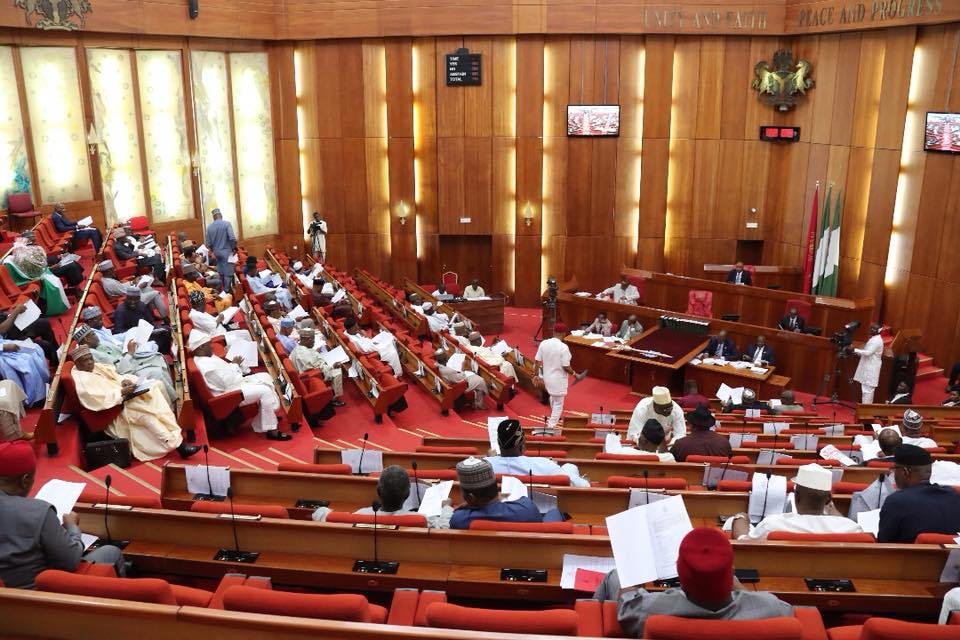
This followed the failure of the Electoral Act Amendment Bill to scale through second reading on the floor during plenary, despite earlier posture by the Senate President, Ahmed Lawan that the amendment must happen, regardless of a court order, barring it from doing so.
Surprisingly, the proposed law, “A bill for an Act to Amend the Electoral Act 2022” was overwhelmingly rejected.
Before a voice vote on the bill, which nays had it, several lawmakers spoke against the further amendment of the Act and urged the Senate to abide by the court ruling, which stopped the National Assembly from tampering with the electoral law.
President Buhari had, in a letter to the National Assembly last week, asked the federal lawmakers to amend the Act, by deleting Section 84 (12), which, according to him, constitutes a “defect” that is in conflict with extant Constitutional provisions.
The section required political appointees to resign their appointment before participating in primary elections as either delegates or candidates.
A Federal High Court in Abuja on Monday barred President Buhari, the Attorney General of the Federation (AGF) and the Senate President from tampering with the Act.
The judge, Inyang Ekwo, in a ruling on an ex parte application by the Peoples Democratic Party (PDP), said the Electoral Act had become a valid law and could not be amended without following the due process of law.
The Court maintained that the Electoral Act, has become a valid law could not be altered without following the due process of law.
But the Senate President, Lawan, on Tuesday, postured that the court ruling would not stop the National Assembly from amending the Electoral Act 2022.
He said the court ruling violated the provisions of the 1999 Constitution (as amended) on Separation of Powers.
However, in the move to reject the bill yesterday, Senator Adamu Aliero fired the first salvo for it to be stepped down after the Senate Leader, Yahaya Abdullahi, moved a motion for the bill to be read a second time.
Aliero, who came under a point of order, drew the attention of his colleagues to the provision of Rule 52(5) of the Senate Standing Order.
Order 52(5) provides that, “Reference shall not be made to any matter on which a judicial decision is pending, in such a way as might in the opinion of the President of the Senate prejudice the interest of parties thereto.”
He, therefore, advised the upper chamber to step down consideration of the bill pending the vacation of the court order delivered by Justice Ekwo Monday.
According to him, going ahead with the amendment of the Act was in clear conflict with the subjudice rule, which prevents the legislature from deliberating or considering any matter already before a court of competent jurisdiction.
“Going ahead to consider the bill obviously will mean that we are disrespecting that order, and this is an institution of the Senate – the symbol of Nigeria’s lawmaking body.
“We should not be seen to be disobeying the court order. No matter how bad that court order is, we should respect it.
“So, I’m of the opinion that we should stop considering this bill pending the time the court sets aside that order and I think I’m speaking the opinion of my colleagues here,” Aliero said.
The Senate President, while ruling on Aliero’s point of order, insisted that the move by the upper chamber to amend the Electoral Act was in line with its Constitutional duties.
“To be specific to this particular request, for us in the Senate, it is to look at the request and follow our due process.
“Looking at the request does not mean granting the request. Members of the National Assembly are at liberty to review the request to see if the arguments by the Executive arm of government are convincing enough.
“If the arguments are not convincing enough, the National Assembly can deny the request, and that is how it is. We have no encumbrance from that order. So, it is for Senators here to decide to vote for this amendment or vote against it, Lawan said.
The Senate leader, Yahaya Abdullahi was then given the floor to lead the debate on the Electoral Act Amendment bill.
Contributing to the debate, Senator Enyinnaya Abaribe (Abia South), kicked against the deletion of Section 84(12) of the Electoral Act as requested by President Buhari.
He said: “There are certain things that we see, which we think we don’t even have to come here to debate.
“One of those things is the fact that in every democracy all over the world, there are certain rules, which we don’t need to be told about. And that is that you cannot be a referee and a player on the same field. It is either you’re a referee or a player.
“So, every other place in the world where democracy is practiced, including Nigeria, we don’t need to be told that if we want to run for office, we have to resign. That is a sine qua non that we don’t even need to debate.
“Yet here we are today in Nigeria, and people think they can sit in an office, become candidates, continue to sit in that office until the date of election and contest the election.
“So, how would we continue to debase democracy in this way?
Mr. President, I think, a cursory look at this paper shows that it is dead on arrival. And I urge you, my colleagues, to help us to continue to deepen democracy by insisting that this bill will not be read a second time in any manner whatsoever.”