

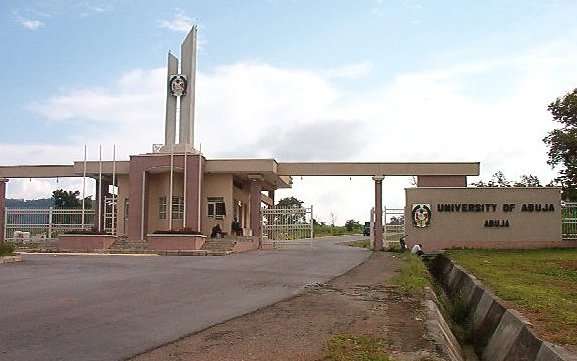

UniAbuja To Graduate 12,624 Students At Combined Convocation
The Vice-Chancellor of the University of Abuja, now Yakubu Gowon University, Professor Hakeem Babatunde Fawehinmi, on Monday announced that a total of 12,624 students will graduate during the institution’s 29th and 30th combined convocation ceremonies, which began on April 10 and will conclude on April 18, 2026.
Addressing journalists at the university’s main campus, the VC described the upcoming ceremony as significant, noting that it marks his “first convocation since assuming office.”
He disclosed that the week-long event began with a Juma’at prayer and inter-denominational church service and will feature a series of academic, environmental, and public engagement activities, including a faculty innovation showcase, a drug awareness lecture, a climate change discussion, and a convocation lecture on artificial intelligence in fintech.
According to Fawehinmi, the university will also confer honorary doctorate degrees on three distinguished Nigerians in recognition of their contributions to society.
The VC outlined, “The main convocation ceremonies will be held on Friday, April 17, 2026, for first degrees, and on Saturday, April 18, 2026, for Higher degrees and the conferment of honorary doctorate degrees, all at the Convocation Square. It is noteworthy that this year, the University will confer Honorary Doctorate Degrees (Honoris Causa) on distinguished Nigerians, including Professor Yusuff Olaolu Ali, SAN, Mr Paul Odili, and Mr Emmanuel Ayuba Iza, in recognition of their contributions to their various fields of endeavours and humanity.”
He added that the institution is proud of its graduates, stating, “We are indeed very proud of our graduands, whom we have trained not only in knowledge and skills but also in character.”
Providing a breakdown of the graduating students, the VC said 7,158 students would graduate from the 2022/2023 academic session, while 5,466 students would graduate from the 2023/2024 session.
He further revealed that the overall best graduating students from both sets would be offered automatic employment at the university.
“Overall, a total of 12,624 students will graduate. For the 29th Convocation (2022/2023 set), the breakdown is as follows: First Class: 48; Second Class Upper: 2,048; Second Class Lower: 4,418; Third Class: 644. Total: 7,158
“For the 30th Convocation (2023/2024 set), the breakdown is as follows: First Class: 29; Second Class Upper: 1,395; Second Class Lower: 3,091; Third Class: 951. Total: 5,466.
“As part of our commitment to the development and advancement of our graduates, the overall best graduating students of both will be given automatic employment in the university to further their careers,” he said.
Fawehinmi highlighted the university’s growth trajectory, noting that it currently has nearly 40,000 students, with projections to reach 50,000 by 2030.
He, however, stressed the urgent need for infrastructural expansion. “There is a sense in which we can tell Nigerians that this federal university needs massive expansion of infrastructure to become the University of our dreams,” he said.
Reflecting on recent challenges, the VC acknowledged past leadership crises within the institution but expressed optimism about its current stability.
“In recent times, the university was faced with leadership and administrative turbulence, marked by tension, disunity, rancour, and mudslinging, all of which were unwholesome for our image.
“The fact that we had three Acting Vice-Chancellors within a short period explains this crisis. We are glad that now, the storm is over,” he said, while commending the efforts of government officials and the university’s governing council in restoring peace.
On academic development, he noted that the university has maintained strong accreditation standards and secured major research funding, including a N4bn intervention for its College of Health Sciences. He also highlighted advancements in medical and public health research, particularly in cardiovascular and sickle cell disease studies.
The VC stressed the institution’s growing global presence through research collaborations and student participation in international competitions. He cited the selection of a student team to represent Nigeria at a global food systems event in Rome later in the year.
In terms of infrastructure, Fawehinmi listed several completed and ongoing projects, including new administrative buildings, a computer-based testing centre, expanded laboratories, improved digital connectivity, and solar-powered staff quarters. He also noted plans to construct 1,500 student bed spaces through a public-private partnership.
On staff welfare, he disclosed that over 100 academic staff had recently been promoted to professorial ranks, describing it as the highest in the university’s history. He added that efforts are ongoing to enhance staff training and welfare, as well as student services.
Addressing discipline, the VC revealed that 28 students were expelled earlier in the year for various offences.
“Our campus is designed for those who are disciplined enough to advance the course of learning. This University has no place for those who violate our culture and discipline,” he said.
He also raised concerns over land encroachment and funding constraints, warning that these challenges could hinder the university’s expansion plans.
The VC lamented, “Despite these achievements, we are not unmindful of the inherent challenges we must continue to address. With our growing student population, the need to expand infrastructure is becoming more pressing.
“Funding remains a challenge, even though we cannot rely on the government entirely as we continue to strengthen our internally generated revenue and block leakages.
“Encroachment on University land from all fronts is also a serious challenge. Even before I assume office, Management had warned that some planned faculties and agricultural research zones would be disrupted by land encroachment and limited funding.”
Despite this, he expressed confidence in the institution’s future. “We, however, believe that with strategic planning, effective management, and strong partnerships with government, alumni, the private sector, and development partners, the university will continue to thrive and maintain its trajectory toward becoming a world-class institution,” he said.
Fawehinmi concluded by appreciating the role of the media in promoting the university’s activities.