

Guterres, Alli‑Balogun, Osaghae, Others Inspire Youth At Lagos Secondary Schools Model UN (LASSMUN)
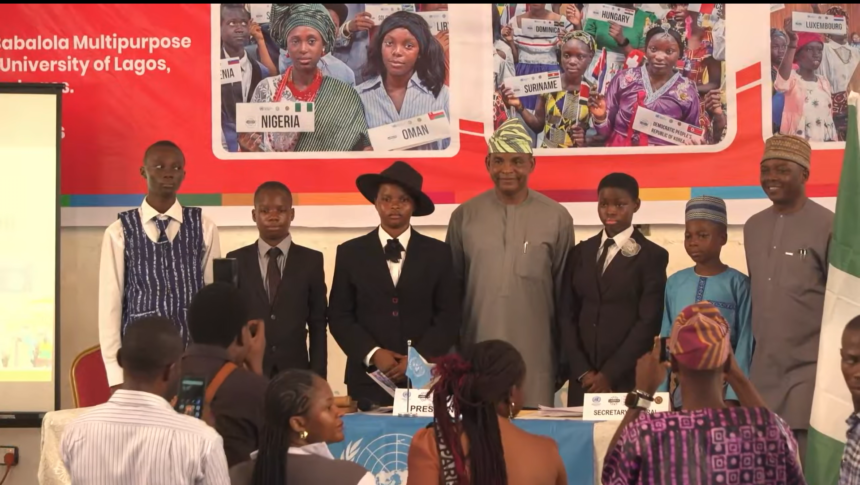
The Seventh Session of the Lagos Secondary Schools Model United Nations (LASSMUN) General Assembly, opened with a strong reaffirmation of the role of young people in shaping a more peaceful, tech-driven and sustainable world, as United Nations representatives, senior government officials, educationists, addressed delegates at the conference themed, “Digital transformation of the educational sector as a driver of sustainable development”.
Welcoming participants, the President of the LASSMUN 2026 General Assembly, Damilola Ogunsanwo, of Epetedo Senior High School, Lagos Island, described LASSMUN as a leadership‑building exercise that goes beyond simulation. He urged delegates to take the proceedings seriously, stressing that the habits of preparation, respect for procedure and willingness to collaborate learned at Model UN mirror the realities of global governance.
United Nations Secretary‑General António Guterres, reaffirmed the UN’s confidence in young people as drivers of positive change. “By taking part in a Model United Nations simulation, you are learning what it takes to build a better world. Across the globe, young people like you are driving change through advocacy, organising, and public service.” He said.
Guterres acknowledged that ‘it takes stamina; a command of the facts; and the courage to see other perspectives, always putting the needs of the most vulnerable first.’
He said that the United Nations is committed to opening more doors for young people to shape the decisions that affect their lives. “Your energy and determination inspire me. Keep using your talents for good.” He added.
The Lagos State Commissioner for Basic and Secondary Education, Mr Jamiu Tolani Alli‑Balogun, underscored the importance of education as a foundation for responsible citizenship and national development. He described LASSMUN as a practical platform for grooming disciplined, articulate and globally aware students who can engage meaningfully with contemporary challenges.
Mr Alli‑Balogun emphasized that the Lagos State Government remains committed to strengthening basic and secondary education, not only through infrastructure and curriculum development but also through initiatives that promote critical thinking, leadership and values‑based learning.
The Commissioner also challenged delegates to see themselves as future leaders whose actions will shape society. He encouraged students to uphold the values of respect, hard work and service, stressing that leadership requires discipline, ethical conduct and a willingness to learn. According to him, the discussions and negotiations at LASSMUN mirror real‑world decision‑making and should inspire participants to contribute positively to their communities, schools and the nation at large.
In her opening remarks, the Tutor‑General/ Permanent Secretary of Lagos Education District III, Mrs Mojisola Christiana Yusuf, highlighted Model UN as an extension of classroom learning that equips students with real‑world skills. She pointed to public speaking, negotiation and teamwork as competencies that are increasingly vital in the 21st century, and commended UNIC for their collaboration with the six Education Districts in Lagos in encouraging students to engage with global issues at an early stage.
She reaffirmed the government’s commitment to initiatives like LASSMUN that promote holistic education. She stressed that leadership begins with responsibility and integrity, encouraging students to see themselves as ambassadors of positive change both within and beyond their schools.
The Director General of the Nigerian Institute of International Affairs (NIIA), Prof. Efosa Osaghae, represented by the Institute’s Director of Research, Prof. Joshua Bolarinwa, noted that by expanding access to education, improving quality, promoting lifelong learning, and supporting innovation, digital technologies could help to address some of the most pressing challenges facing societies today.
“However, realizing this potential requires a strategic and inclusive approach that addresses existing barriers and ensures that the benefits of digital transformation are equitably distributed. This includes investing in digital infrastructure, promoting digital literacy, and developing supportive policies and frameworks.” He said.
Prof. Osaghae added that the integration of digital technologies into education was not just a technological shift but a fundamental reimagining of how education could contribute to a more sustainable and equitable future.
The Director of the United Nations Information Centre (UNIC) Abuja, Mr Ronald Kayanja, who spoke extensively on the importance of youth participation in advancing the ideals of the United Nations, reminded delegates that young people were not only future leaders, but present‑day stakeholders whose ideas, energy and innovation were essential to addressing global challenges.
Kayanja emphasised that the United Nations placed young people at the heart of its work on peace, sustainable development, climate action and human rights. He encouraged students to use the Model UN platform to better understand the values enshrined in the UN Charter, including dialogue, tolerance, respect for diversity and international cooperation. He stressed that these principles are not abstract ideals, but practical tools for resolving disputes and building inclusive societies.
He also highlighted the importance of informed engagement, urging delegates to rely on facts, credible sources and critical thinking in an era marked by misinformation and polarized discourse. According to him, Model UN helps young people develop the ability to separate opinion from evidence and to communicate responsibly—skills that are increasingly vital in today’s information landscape.
Mr Kayanja further encouraged delegates to see their participation as part of a larger global youth movement working with the United Nations to achieve the Sustainable Development Goals. He challenged students to take the lessons of diplomacy, empathy and collaboration learned at LASSMUN back to their schools and communities, noting that global citizenship begins with local action.
The Secretary‑General of the conference, Praise Oyekunbi of Babs Fafunwa Millennium Senior Secondary School Ikeja, emphasised that “digital transformation is not about tablets gathering dust in storerooms. It is about resilience. When floods erase classrooms, cloud-based learning preserves continuity. When children are excluded from physical schools, digital access can become their gateway to opportunity. When learners lack teachers, adaptive technology can help bridge the gap. But let us be clear: technology without equity is not progress, it is injustice.”
Ms Genevieve Chukwuezi, representing the Head of Office, UNDP Lagos, William Tsuma, highlighted the role of technology in development. She referenced the COVID-19 lockdown era when schools were shut down, leaving millions of learners emphasising that technology could enhance access and resilience.
She noted that digital transformation was not just about technology, “it is about access, and opportunities, it is about moving from learning to creating, converting innovation to investments, and turning ideas into products and real solutions that are scalable.”